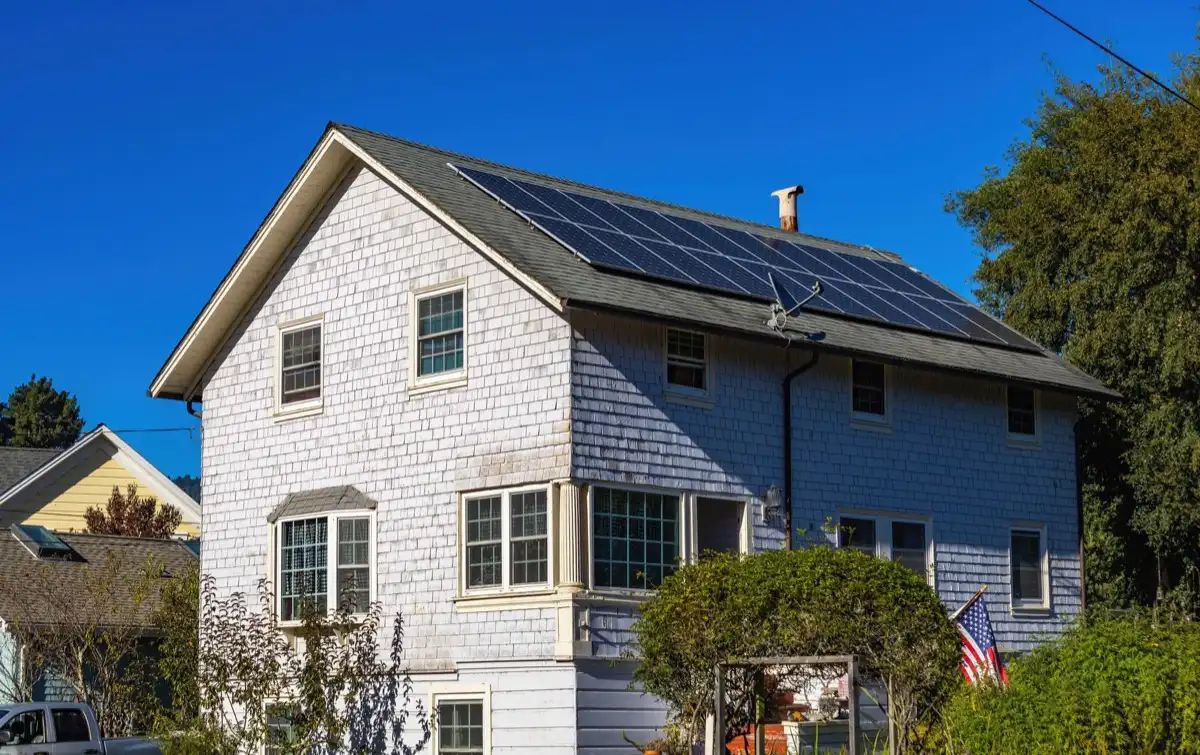
The federal solar tax credit is finished. Not reduced, not phased down. Public Law 119-21, enacted 4 July 2025, amended 26 U.S.C. 25D at section 70506 so that the credit "shall not apply with respect to any expenditures made after December 31, 2025."
That single change rewrites the arithmetic in every solar proposal written before it. This page is the checklist that survives it: what the law says, the timing rule that will catch people who signed in 2025, and the four things that now decide whether an array is a good purchase. It is information rather than tax advice, and nothing here can tell you what your own return looks like.
What the statute says, and where the IRS says it
Section 25D is the Residential Clean Energy Credit — the 30% one that covered solar panels, batteries and geothermal. Its termination subsection now reads that the credit does not apply to expenditures made after 31 December 2025. The IRS carries the same limit on its own page for the credit, describes the 30% rate as applying to qualified property installed from 2022 through 31 December 2025, and published Fact Sheet FS-2025-05 on 21 August 2025 covering the accelerated terminations in the July law.
The companion credit ended on the same date by a separate section of the same act. Section 25C, the Energy Efficient Home Improvement Credit covering insulation, windows, skylights, doors and heat pumps, was terminated by section 70505 for any property placed in service after 31 December 2025. That matters here because the efficiency work that belongs ahead of any array was running on it.
One warning about checking this yourself. A search will still return confident pages saying the credit is available, and some of them are on irs.gov. Pages describing the rule for tax years that have closed are archived rather than removed, and they read as current because nothing on them announces otherwise. Read the date range inside the sentence, not the domain it arrived on.
The timing rule that catches people who signed in 2025
This is the part with actual victims, and it is the reason this section sits near the top.
The law does not ask when you paid. Section 25D(e)(8) treats an expenditure as made when the original installation of the item is completed, and the IRS guidance on the 2025 act applies that straight to the cutoff: where installation was completed after 31 December 2025, the expenditure counts as made after 31 December 2025.
So a deposit written in November against a system energized in March is on the wrong side of the line. So is a signed contract, a submitted permit, a paid-in-full invoice and an ordered pallet of panels. The only date that carries weight is the day installation was finished.
If that describes your project, two conversations are worth having in order. A tax professional first, because the answer depends on a return nobody selling panels has seen. Then the installer, with the contract open at whatever it says about incentives and about delay, because the savings case you agreed to was built around a number that is not going to arrive.
A credit was never a rebate
Anyone filing or amending for a year when the credit was live still needs this distinction. It caused more disappointment than any other feature of the credit while it existed.
A rebate is money sent to you. A credit reduces the federal income tax you owe. A household whose liability for the year came in under the credit did not capture all of it that year, and section 25D carried the unused portion forward rather than paying it out.
That carryforward is the one piece still moving. It belongs to expenditures already made, and it does nothing for a system installed now. If a salesperson subtracts a full federal credit from a price in front of you today, they are quoting a rule that no longer exists — which is a useful thing to learn about a company before you sign anything.
Every proposal written before 2026 needs re-running
A quote produced while the credit was alive had roughly 30% of the system price taken out of its payback calculation. Take that back out and the same array on the same roof pays for itself over a materially longer stretch of years.
That is not an argument against solar. It is an argument against carrying an old spreadsheet into a new decision.
Ask each bidder to produce their savings and payback estimate with no federal credit line in it at all, and to put it beside the version they first showed you. The gap between those two documents is the actual question in front of you, and a company that cannot generate the second one has told you something about how the first was assembled.
State and utility incentives are separate programs, set locally, and were not touched by the federal change. They are worth checking on their own terms — through your state energy office and your utility rather than through the installer's summary of them.
Compare in dollars per watt, before anything is subtracted
Here is the discipline that makes three quotes comparable, and it does more work now than it did when a credit was flattening the differences.
Ask each company for two things: the system size in kilowatts, and the gross price before any incentive at all. Divide the second by the size in watts. That price per watt is the number you rank.
A larger system costing more is not a worse deal, and a smaller one costing less is not a better one. Without normalizing by size you are comparing a total for one quantity of equipment against a total for another, which tells you nothing.
Do this before you look at monthly payments. A payment is the output of a financing decision, and a long enough term makes almost any price look manageable.
What exported power is worth now decides the payback
If you verify one thing on this list, make it this one. With the federal credit gone, the export tariff is the largest single variable left in the calculation.
Net metering and interconnection terms decide what a kilowatt hour is worth when your array produces it and the house is not using it. Under full retail net metering that exported unit offsets a unit you would otherwise buy. Under a thin export rate it is worth a fraction of that.
Same panels, same roof, same installer, completely different payback. These rules come from state regulators and utilities, which means the arithmetic in a national sales presentation may have nothing to do with your address.
Ask the utility directly, in writing. Which tariff applies, whether it is locked for a term, and what happens to existing customers when the tariff changes. Then ask the installer to rebuild their production and savings estimate on that tariff rather than a generic one.
Size the system to your bills, not to the roof
Pull twelve months of electricity bills and total the kilowatt hours. That number, not the available roof area, is where sizing starts.
A system built well past your consumption produces power you may be credited very little for, depending on the answer to the previous section. Oversizing is the most common way for a project's price to grow without its payback improving, and it was easier to hide while a percentage credit made a bigger system look proportionally cheaper.
Ask for the production estimate and the shading analysis behind it, then compare estimates across bidders for the same roof. Where one company's projection sits far above the others, that gap is information about the company rather than about your roof.
Replace the roof first
Mounting panels over a roof covering near the end of its service life creates a bill nobody plans for. When the roof is replaced, the array comes off and goes back on, and that removal and reinstallation is a real line item landing a few years after everyone thought the project was done.
Do the roof, then the array, even where that delays things by a season. It is one of the few sequencing questions in home improvement with an answer that is not debatable, and our roof replacement cost guide covers how to tell where a covering actually stands.
While the array is being designed, ask where the penetrations go, how they are flashed, and whose warranty covers a leak at a mount. That last question has a habit of producing a pause.
Read the financing harder than the equipment
Cash, a loan, a lease and a power purchase agreement are four different products with four different risk profiles, and only the first two leave you owning the system.
On a loan, find the dealer fee built into the price — it is usually why a cash price and a financed price differ. Then read the amortization. A great many solar loans were written on the assumption that the borrower would drop a large voluntary payment against the principal within the first eighteen months, funded by a federal credit. Where that structure is still in a contract being offered now, the payment steps up at the end of that window and there is nothing to cover it.
On leases and power purchase agreements, the two clauses that cause regret are the annual payment escalator and the transfer terms when you sell the house. A buyer who does not want to assume the agreement becomes a problem you inherit at the closing table.
When to skip it
Four situations turn a good product into a poor purchase, and none of them is a criticism of solar.
A heavily shaded roof will not carry a payback, and optimizers reduce that penalty rather than removing it. A short remaining stay in the house means somebody else collects savings you paid for. A utility that pays very little for exports stretches the payback past the point most people care about. And a roof with only a few years in it turns a finished project into a future removal and reinstall.
Where none of those applies, and the export tariff is favorable, solar is still one of the more straightforward purchases on this site — bought now on its own economics rather than on a subsidy. The full set of variables, including how to read a production estimate, is in our solar panel installation cost guide.
And if the goal is a lower bill rather than an array specifically, the cheap work comes first: air sealing, insulation, and the equipment that runs the most hours. That order was correct while both credits existed. With neither of them left to distort the comparison, it is simply the arithmetic.
Ready for a free quote in Nationwide?
America's Home Savings — free estimate, clear scope, no pressure. Use the form on this page or jump to the homepage quote.
Related services in Nationwide
America's Home Savings money pages — go straight to the service you need.
- Roof Replacement →
Roof replacement cost is set by the roof, not by the house underneath it. Pitch, squares, tear-off layers, decking condition and flashing decide the bid before anyone picks a shingle color, and those five are exactly what a thin quote leaves vague.
- Solar Panels →
Solar panel installation cost is quoted two different ways, and only one of them lets you compare two companies. Ask every bidder for the system size in kilowatts and the gross price per watt before any incentive, because a total that has already had credits subtracted hides both the size and the markup.
- Replacement Windows →
Window replacement cost moves on three things: how many openings, what the frame is made of, and whether the crew is fitting an insert or doing a full-frame replacement. Energy efficient windows are the upsell inside every quote, and whether they pay for themselves depends on two numbers printed on a sticker rather than on anything in the brochure.
- Inground Pools →
Inground pool cost, as quoted, is the smallest number in the project. The shell is what the contract covers, and the deck, the fence, the water, the electrical work, the heater and the yearly running cost are what actually decide whether a pool fits the budget you had in mind.
- Pest Control →
Pest control cost is usually sold as a recurring plan, and the plan rather than the first visit is where the money is. Termite treatment cost is a separate purchase priced by the linear foot of foundation and by method, and of the two it is the one that is genuinely worth getting right.
Frequently asked questions
Is there still a federal solar tax credit?
No. Public Law 119-21, enacted 4 July 2025, amended 26 U.S.C. 25D at section 70506 so that the Residential Clean Energy Credit does not apply to expenditures made after 31 December 2025. The IRS states the same limit on its own Residential Clean Energy Credit page and covered the change in Fact Sheet FS-2025-05, published 21 August 2025.
There is no step-down and no reduced rate underneath it. Searching the phrase will still return pages saying the credit is available, because IRS pages describing the rule for tax years that have closed are archived rather than deleted.
I paid a deposit in 2025 but the install slipped into 2026. Does that count?
The law keys off installation rather than payment. Section 25D(e)(8) treats an expenditure as made when the original installation of the item is completed, and the IRS guidance on the 2025 act applies that to the cutoff directly: where installation finished after 31 December 2025, the expenditure was made after 31 December 2025.
A deposit, a signed contract, a permit or even payment in full does not move that date. What your own return looks like is a question for a tax professional, and it is worth asking early rather than in April.
Was the solar tax credit a rebate?
It never was, and that distinction still matters to anyone filing or amending for a year when the credit was live. It reduced federal income tax owed rather than arriving as a check, so a household whose liability was smaller than the credit did not capture all of it in the year of installation.
Section 25D carried the unused portion forward to a later year instead of paying it out. That carryforward attaches to expenditures already made and not to anything installed now.
Why should I compare quotes before incentives?
Because a total that has already had something subtracted hides both the system size and the markup, and that habit is what left so many households unable to tell what changed when the federal credit ended. Ask every bidder for the system size in kilowatts and the gross price, then divide to get the price per watt.
That single number turns three unrelated totals into three figures you can rank. Do it before you look at the monthly payment, which is a financing question rather than a price.
What decides the payback now that the credit is gone?
What your utility pays for exported power, more than anything else on the page. Full retail net metering and a thin export rate produce completely different arithmetic from the same array on the same roof, and the rules are set by state regulators and utilities rather than nationally.
Ask the utility directly, in writing, which tariff applies at your address and whether it is locked for a term. State and utility incentives are separate programs and were not touched by what Congress did to section 25D.
When is solar the wrong purchase?
A heavily shaded roof, a short remaining stay in the house, a utility that pays very little for exported power, or a roof due for replacement within a few years can each turn a good product into a poor purchase. Leases and power purchase agreements deserve separate caution, because the payment escalator inside them and the transfer terms at sale are the clauses that cause regret.
Local context
How this applies in Nationwide, US
Every article here is written from home savings work done in Nationwide and all fifty states, so the numbers reflect local labour, permit and material costs rather than a national average. Your own job can land either side of them depending on access, the condition of what is already there, and the materials you pick — UL 2218 Class 4 impact ratings, ASTM D7158 wind class ratings, NFRC U-factor and solar heat gain labels.
The way to turn any of this into a real answer is to have someone look at your actual situation. The free estimate is free, itemized and written down, with no deposit and no obligation. Call (866) 346-6987 or start on the America's Home Savings homepage.
Areas America's Home Savings covers
Nationwide first, then the surrounding communities of all fifty states. Each has its own page with local detail rather than a copy of this one:
Or jump to the full list of Nationwide services.
More from the America's Home Savings blog
- Pool Resurfacing Cost: How to Tell the Surface Is Done
Pool resurfacing is priced by surface area and finish, and it arrives on a schedule. How to tell a worn surface from a failed one before you take a quote.
- Asphalt Roof Replacement Cost: What Actually Moves the Bid
Asphalt roof replacement is priced by the square, and five line items decide the total. Here is how to read three bids as one scope before you compare totals.
- Vinyl Replacement Window Cost: Where the Money Actually Goes
Vinyl replacement windows are priced per opening, and the install method matters more than the brand. How to read a window quote and when to keep yours.
The America's Home Savings Team
home savings specialists serving Nationwide, US
Written by the America's Home Savings team — insured home savings pros serving Nationwide, US and the surrounding area.